Cordless paint sprayers sound pretty amazing at first. No extension cord. No hunting for an outlet.
No dragging a power cord across the yard, around furniture, or through wet grass while you are trying to finish a project.
For DIY homeowners, that convenience is a big deal.
So, are cordless paint sprayers worth it?
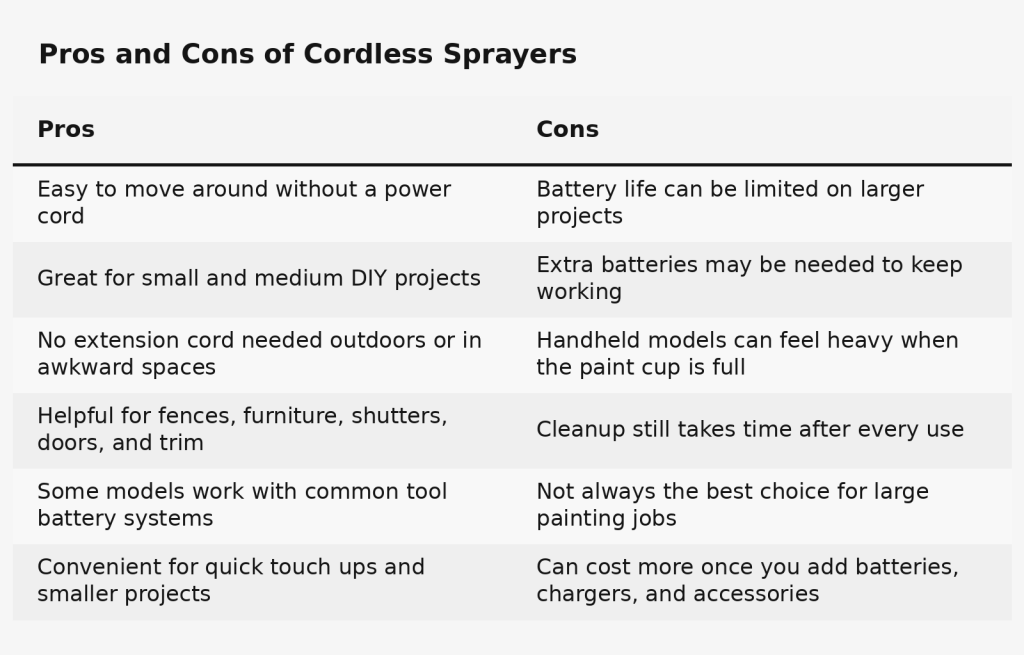
Pros and Cons of Cordless Sprayers
A cordless sprayer can make small and medium paint projects feel a lot easier, especially if you are spraying a fence, shed, garage door, furniture, cabinets, shutters, trim, or outdoor decor.
But cordless sprayers are not perfect. They still need prep, cleaning, masking, thinning in some cases, and enough battery power to get through the job.
So, are cordless paint sprayers worth it?
The answer depends on what you are painting, how often you plan to use the sprayer, and whether convenience matters more than nonstop power.
What Is a Cordless Paint Sprayer?
A cordless paint sprayer is a battery powered sprayer that lets you spray paint, stain, sealer, or finish without plugging into an electrical outlet.
Some cordless sprayers are handheld units with a paint cup attached directly to the sprayer. Others are larger cordless airless sprayers or backpack style sprayers made for bigger projects. The main benefit is the same; you can move around more freely without managing a power cord.
Cordless sprayers are usually designed for homeowners, DIYers, furniture painters, and small project users, though some higher end cordless sprayers are also used by contractors for touch ups and smaller jobs.
Done; I created it in the same clean gray table style.
Pro: Cordless Sprayers Are Easy to Move Around With
The biggest benefit of a cordless sprayer is portability.
If you are painting a fence, deck railing, shed, mailbox post, patio furniture, shutters, or garage door, not being tied to an outlet is genuinely helpful. You can move around the project more naturally, which makes spraying feel less awkward.
This is especially useful outdoors, where outlets are not always close by. You also do not have to worry as much about tripping over an extension cord or dragging it through fresh paint.
For smaller DIY projects, that freedom can make the whole job feel simpler.
Pro: They Are Great for Quick Projects
Cordless paint sprayers are especially helpful for projects that are too large for a spray can but not quite large enough to justify setting up a bigger sprayer.
Good examples include:
- Patio chairs
- Small fences
- Cabinet doors
- Interior doors
- Shutters
- Planter boxes
- Small sheds
- Wooden benches
- Garage shelving
- Trim pieces
A cordless sprayer can help you get a smoother finish than a brush, and it can be much faster on surfaces with slats, grooves, spindles, or texture.
If you only need to spray for a short stretch, the convenience is hard to beat.
Pro: No Extension Cord Needed
Extension cords can be annoying during paint projects. They get in the way, catch on corners, and sometimes pull against the tool right when you are trying to keep your spray pattern smooth.
With a cordless sprayer, you can set up your project wherever it makes the most sense. That might be in the driveway, on a covered patio, in the garage, or out near the fence line.
This can also make setup and cleanup feel less overwhelming. For a lot of homeowners, that matters because the easier a tool is to set up, the more likely it is to actually get used.
Pro: Some Models Use Common Tool Batteries
One nice feature of some cordless sprayers is that they work with common tool battery platforms. Certain cordless airless sprayers are advertised as compatible with widely used 20V lithium ion batteries and may spray up to one gallon per charge, depending on the model and material being sprayed.
That can be helpful if you already own tools that use the same battery system. Instead of buying into a completely separate battery setup, you may be able to share batteries across multiple tools.
That said, battery compatibility always needs to be checked carefully before buying. Do not assume every sprayer works with the batteries you already own.
Con: Battery Life Can Be Limited
Battery life is probably the biggest drawback of cordless sprayers.
Some cordless HVLP sprayers list approximately 7 to 20 minutes of runtime on one fully charged battery, depending on the coating, nozzle, and settings. Another manufacturer FAQ lists 7 to 15 minutes of continuous spraying at the highest air power setting for one cordless model.
That does not mean you can only work for 15 minutes total. Most DIY spraying involves pauses for refilling, repositioning, checking coverage, and moving parts around. But it does mean that bigger projects may require extra batteries.
For small furniture projects, battery life may be fine. For a long fence or a full exterior project, it may become frustrating.
Con: Cordless Sprayers Can Feel Heavy
A handheld cordless sprayer carries the motor, battery, paint cup, and paint all in your hand. That can get heavy fast, especially when the cup is full.
This matters more than people think. A sprayer may feel fine when you pick it up empty in the store, but after 20 minutes of spraying overhead, sideways, or around furniture, your hand and wrist may feel it.
If you have a lot of vertical work, overhead work, or detail spraying, weight should be part of your buying decision.
A lighter sprayer may be easier to control, but it may also hold less paint. A larger sprayer may cover more area, but it can be tiring to use for long stretches.
Con: You May Need Extra Batteries
If you are buying a cordless sprayer for more than small projects, extra batteries are almost a must.
A second battery lets you keep working while the first one charges. For bigger outdoor jobs, two or three batteries can make the difference between a smooth project and a frustrating stop and start experience.
This is an important cost to think about. A cordless sprayer may look affordable at first, but the price can climb once you add extra batteries, a charger, replacement cups, liners, filters, and cleaning supplies.
Con: Cleanup Still Takes Time
Cordless does not mean low maintenance.
You still need to clean the sprayer properly after each use. That includes the paint cup, nozzle, spray tip, filter, pickup tube, and any parts that touched paint or stain.
This is where some beginners get disappointed. The spraying part may be fast, but cleanup is still part of the job. If paint dries inside the sprayer, you can end up with clogs, poor spray patterns, or a sprayer that stops working completely.
For most DIY homeowners, I would only recommend a cordless sprayer if you are willing to clean it right away after every project.
Con: They Are Not Always Best for Big Jobs
Cordless sprayers are convenient, but they are not always the best choice for large projects.
If you are painting an entire house exterior, multiple rooms, a long fence, or a large deck, a corded airless sprayer may be a better fit. Bigger corded sprayers usually offer more consistent power, larger paint capacity, and no battery interruptions.
Cordless sprayers shine when mobility is more important than nonstop production.
That makes them great for small and medium DIY jobs, but not always ideal for full scale painting.
A Quick Safety Note
Spray painting should be done with strong ventilation, and OSHA guidance for spray finishing requires ventilation to remove flammable vapors, mists, or powders to a safe location. Leftover paint, solvents, and related products may also need special disposal, since the EPA notes that some household products can catch fire, react, or contain hazardous ingredients.
Are Cordless Sprayers Worth It?
Cordless sprayers are worth it if you value convenience, portability, and easy movement around small or medium projects.
They are a good fit for DIY homeowners who want to paint furniture, fences, shutters, cabinet doors, shelves, trim, outdoor decor, or smaller home projects without dealing with cords.
They may not be worth it if you mostly paint large areas, need long continuous spray time, or do not want to buy extra batteries.
A cordless sprayer is not automatically better than a corded one. It is better for certain situations.
Conclusion
The biggest pros of cordless sprayers are portability, convenience, and freedom from extension cords. They are easy to move around with, useful for outdoor projects, and a nice option for DIY homeowners who want a smoother finish on small and medium jobs.
The biggest cons are battery life, weight, cost, and cleanup. You may need extra batteries, and you still have to clean the sprayer carefully after every use.
For most homeowners, a cordless sprayer makes sense if you plan to use it for furniture, fences, shutters, cabinets, doors, or quick outdoor projects. If you are painting large areas for hours at a time, a corded airless sprayer may be the better choice.
In the end, cordless sprayers are all about convenience. If you buy one with realistic expectations and the right accessories, it can be a very handy tool to have around the house.the best chance to look smooth, bond properly, and hold up over time.
- Pros and Cons of Cordless Sprayers
- What Is a Cordless Paint Sprayer?
- Pro: Cordless Sprayers Are Easy to Move Around With
- Pro: They Are Great for Quick Projects
- Pro: No Extension Cord Needed
- Pro: Some Models Use Common Tool Batteries
- Con: Battery Life Can Be Limited
- Con: Cordless Sprayers Can Feel Heavy
- Con: You May Need Extra Batteries
- Con: Cleanup Still Takes Time
- Con: They Are Not Always Best for Big Jobs
- A Quick Safety Note
- Are Cordless Sprayers Worth It?
- Conclusion